News
“Making Cities Resilient” in Brazil
October 14, 2014
On Aug. 15th, Peace Boat arrived in Belem, Brazil.
Disaster Risk Reduction is a topical and important issue in Brazil, given that the nation faces a wide range of natural hazards, including landslides, floods, and drought.
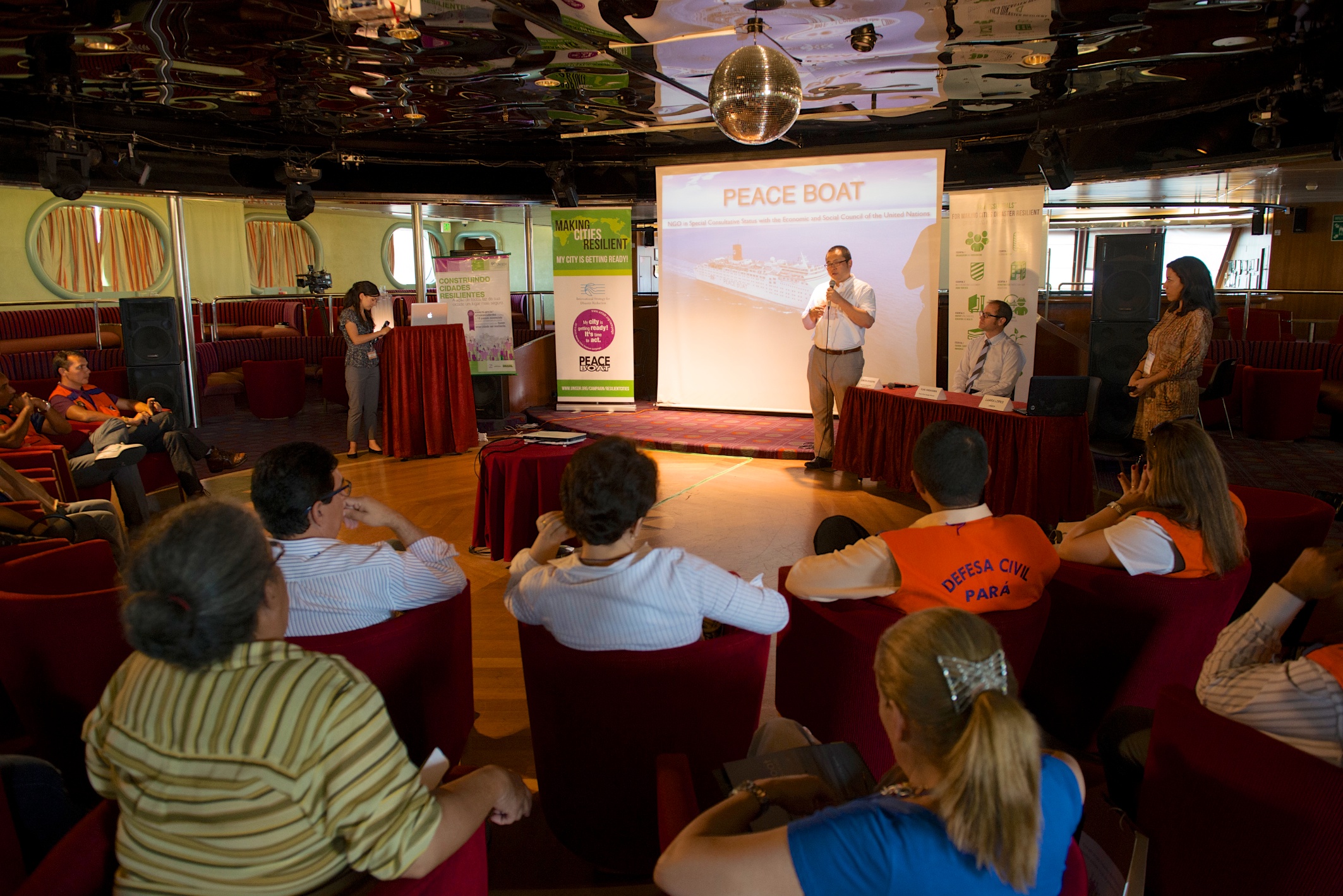
In Belem, Peace Boat held a press conference and symposium with 19 government officials and DRR professionals onboard the ship, along with official representation from UNISDR.
After an introduction to the “Making Cities Resilient” campaign (of which Peace Boat is an official campaign partner), the participants engaged in a lively discussion on how to achieve disaster resilience in their local areas.
This event served as a prime opportunity to exchange opinions, share information and build relationships that can ultimately help enhance the region’s ability to cope with disasters and adapt to climatic conditions.
The representatives of Belem stated that the press conference and symposium, along with the new connections made through the event, had given them the motivation to sign up for the campaign and pledge their commitment to the cause.
The campaign, originally introduced to facilitate implementation of the Hyogo Framework for Action (HFA) at the local level, provides tools to governments to enable them to build more resilient cities and ultimately reduce the negative impacts incurred from disasters.
Working towards the Third United Nations World Conference on Disaster Risk Reduction (WCDRR) in Sendai next year, Peace Boat will continue to raise awareness of this campaign and rally local governments to renew their efforts in building resilient cities.
PBV Annual Report 2013/2014
September 17, 2014
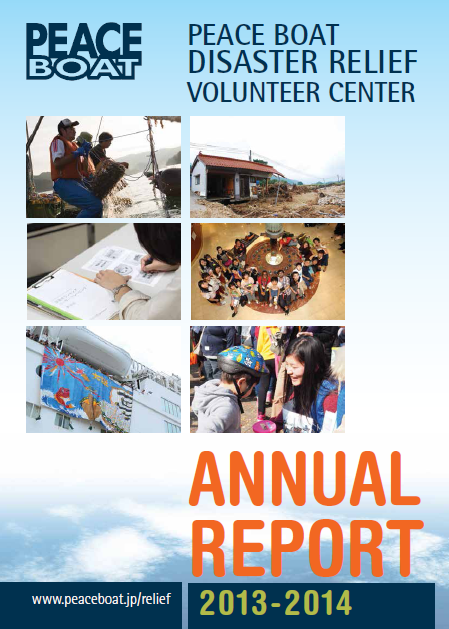
PBV’s English-language Annual Report for the 2013/2014 fiscal year is now available online!
From international disaster relief to Tohoku recovery programs, the annual report covers all of PBV’s activities that took place between April 2013 and March 2014.
This report is a way of keeping our friends, supporters and partners up-to-date, and is also part of our commitment to staying transparent and accountable in all that we do.
Please click HERE to view the Annual Report in PDF format (1.42 MB).
Thank you to all of our supporters and friends around the world for making the 2013/2014 fiscal year a success!
For any questions/comments, please contact relief[at]peaceboat.gr.jp
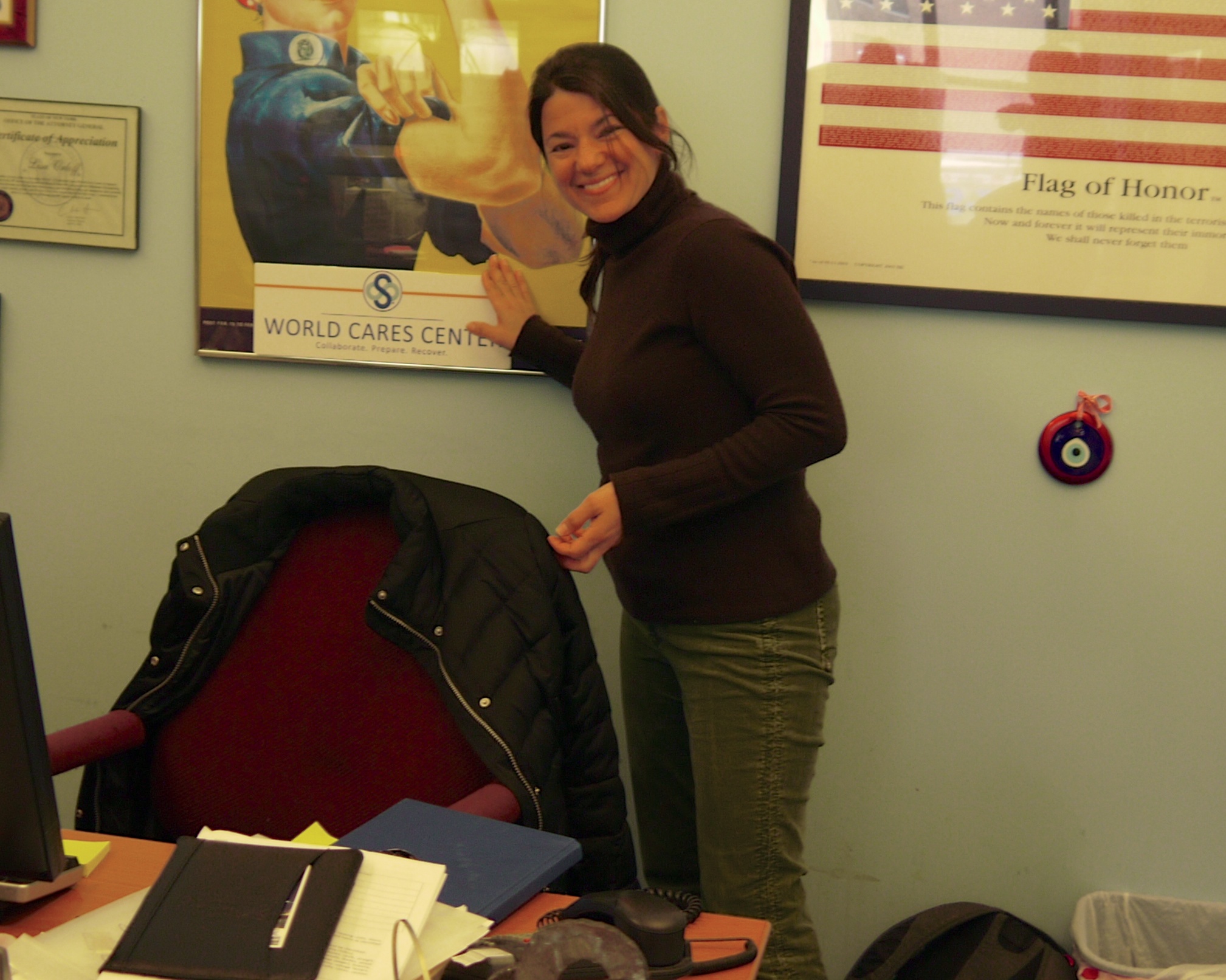
Guest Speaker: Lisa Orloff, NPO World Cares Center (Peace Boat Center Tokyo, March 26th 2014)
March 13, 2014
Peace Boat is proud to welcome Lisa Orloff, Founder and Executive Director of NPO ‘World Cares Center’, to speak at the Tokyo Peace Boat Center on March 26th.
The New York-based nonprofit, established after the 9.11 terrorist attacks, empowers communities through disaster response coordination and delivers disaster preparedness trainings to communities both in the US and abroad.
Lisa will be speaking about her work supporting survivors and responders in the wake of the 9.11 terrorist attacks, as well as her extensive work with communities affected by Hurricane Sandy in New York. She will also discuss the role of volunteers in disaster time, disaster volunteer systems in the USA and the importance of Japan-US relations in the context of international disaster relief.
[Date] March 26th 2014 (Wed)
[Time] 19:00~20:30
[Place] Tokyo Peace Boat Center (http://peaceboat.jp/relief/contact/)
[Participation Fee] 300 yen
http://www.peaceboat.org/event (日本語)
Fukushima Youth Ambassadors: Spring 2014
February 21, 2014
On March 11, 2011, Fukushima residents were forced to face the terror of the nuclear accident at the Daiichi Nuclear Power Plant in the wake of the 9.0-magnitude earthquake and devastating tsunami that followed.
Almost three years on, while progress has been made from the devastation of the tsunami in some areas, the nuclear disaster is far from over. Reports of leaking water tanks at the nuclear site and other hazards indicate that not only do areas remain contaminated, but radiation levels persist and the long-term effects on the health of the population are yet to be determined. In addition to health concerns from exposure to radiation, survivors are under tremendous pressure and stress. Survivors of the disaster have to cope with psychosocial issues such as trauma, fear, separation from family and/or family breakdown, economic strains, community pressures, anxiety and depression.
In this situation, it is the youth and children who are most at risk. In cases where long-term evacuation is not possible, providing opportunities for youths to take a break from these stressful and potentially life-threatening conditions during their school holidays is vital for their long-term health and welfare. Through travel, education initiatives and exchange programmes, youth from Fukushima are able to gain a global perspective, rewarding first-hand experiences, and build friendships to give hope for the future.
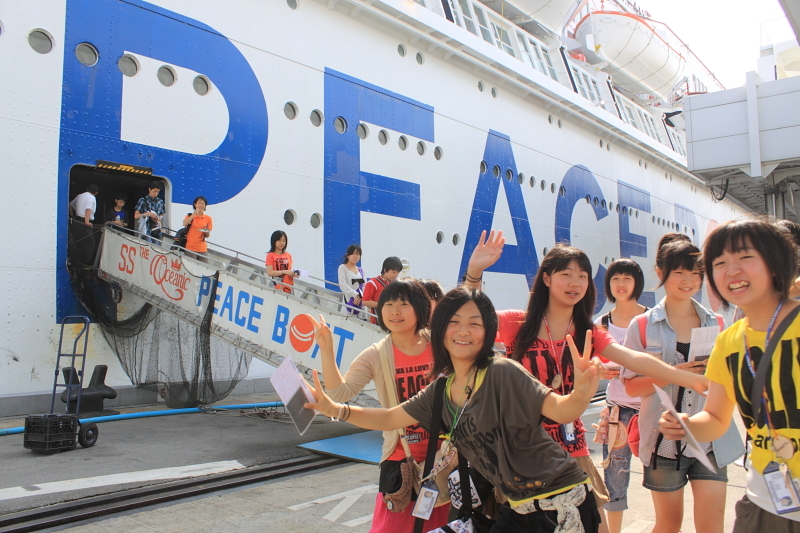

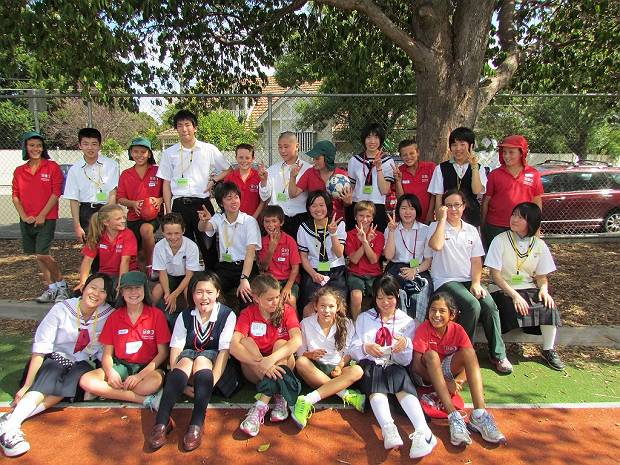
Peace Boat Disaster Relief Volunteer Center (PBV) would like to announce the launch of the Fukushima Youth Ambassadors: Spring 2014 Programme.
The programme will be organized in partnership with Fukushima-based nonprofit “Minamisoma Kodomo no Tsubasa”. Twelve junior high school students from Fukushima will be visiting Singapore, a nation celebrated for its multicultural heritage, and Sri Lanka, a country steeped in history that is home to a diverse range of religions, ethnicities and languages.
Students will learn and experience first-hand the importance of embracing diversity in multicultural societies and will explore how humans can learn to co-exist peacefully despite our differences.
In Sri Lanka, Peace Boat is scheduled to hold an exchange between the Fukushima Youth Ambassadors and survivors of the 2004 Indian Ocean Earthquake and Tsunami, fostering a sense of solidarity between disaster-affected communities across borders and forging new friendships for the future.
The students will be onboard Peace Boat’s 83rd Global Voyage for Peace between Singapore and Sri Lanka, where they will study English and communication skills with a range of specialized Guest Educators. Their time onboard will also allow ample opportunity to meet and build friendships with the hundreds of passengers, staff and crew.
[Project Period] March 21st 2014 – April 1st 2014
[Participants] 12 Junior High School Students from Minamisoma City
[Schedule]
March 21st – Depart Minamisoma, Fly to Singapore
March 22nd – Singapore Sightseeing/Exchange Programme
March 23rd to March 28th – Onboard Peace Boat’s 83rd Global Voyage for Peace
March 29th to March 30th – Colombo (Sri Lanka) Sightseeing/Exchange Programme
March 31st – Depart Colombo, Fly to Japan
Calling for donations to support the “Fukushima Youth Ambassadors: Spring 2014” programme -
Within Japan
- Postal Transfer
Postal Transfer Account : 00120-9-488841
Account Name: Peace Boat Saigai Volunteer Center
※Please fill in “Fukushima” in the Memo Field
- Bank Account
Yuucho Bank
Branch Zero One Nine (Branch 19):
Interim 0488841
Account Name: Peace Boat Saigai Relief Center
※Before the transfer request name, please write “Fukushima”
Example) “Fukushima Yamada Tarou”
※Please contact for transfers by Tokyo-Mitsubishi UFJ and Mizuho Bank
Japan CSO Coalition for 2015 3rd World Conference on Disaster Risk Reduction (JCC2015)
January 28, 2014
January 19th 2014 marks 19 years since the Great Hanshin-Awaji Earthquake. The disaster claimed thousands of lives and devastated the city of Kobe, leaving in its wake a profound sense of loss across the nation.
In one of the most earthquake-prone countries in the world, the disaster served as a chilling reminder of the importance of disaster preparedness, mitigation and prevention in the aim of minimizing loss of human life and human suffering during times of disaster.
In 2005, Kobe hosted the 2nd World Conference on Disaster Risk Reduction (WCDRR) 10 years on from the disaster. During this conference, national representatives from all over the world came together to adopt the Hyogo Framework for Action (HFA), a set of guidelines aiming to improve disaster preparedness measures globally over the course of 10 years.
In March 2015 – the 10th year since the adoption of the HFA – Sendai will host the 3rd World Conference on Disaster Risk Reduction. Sendai, the largest city in the disaster-affected Tohoku region, is set to host this conference, illustrating the importance of experiences and lessons from the Great East Japan Earthquake on global disaster-related policies.
Given the extensive experiences and contributions of non-profit and non-governmental groups in the relief efforts after the Great East Japan Earthquake and Tsunami, it is imperative that these stakeholders are involved in the 3rd WCDRR. Leading up to the conference, a large number of Japan-based civil society groups have come together to share experiences and lessons learnt from their respective disaster-related activities.
As a result, Japan CSO Coalition for 2015 WCDRR (JCC2015) was established on January 10th.
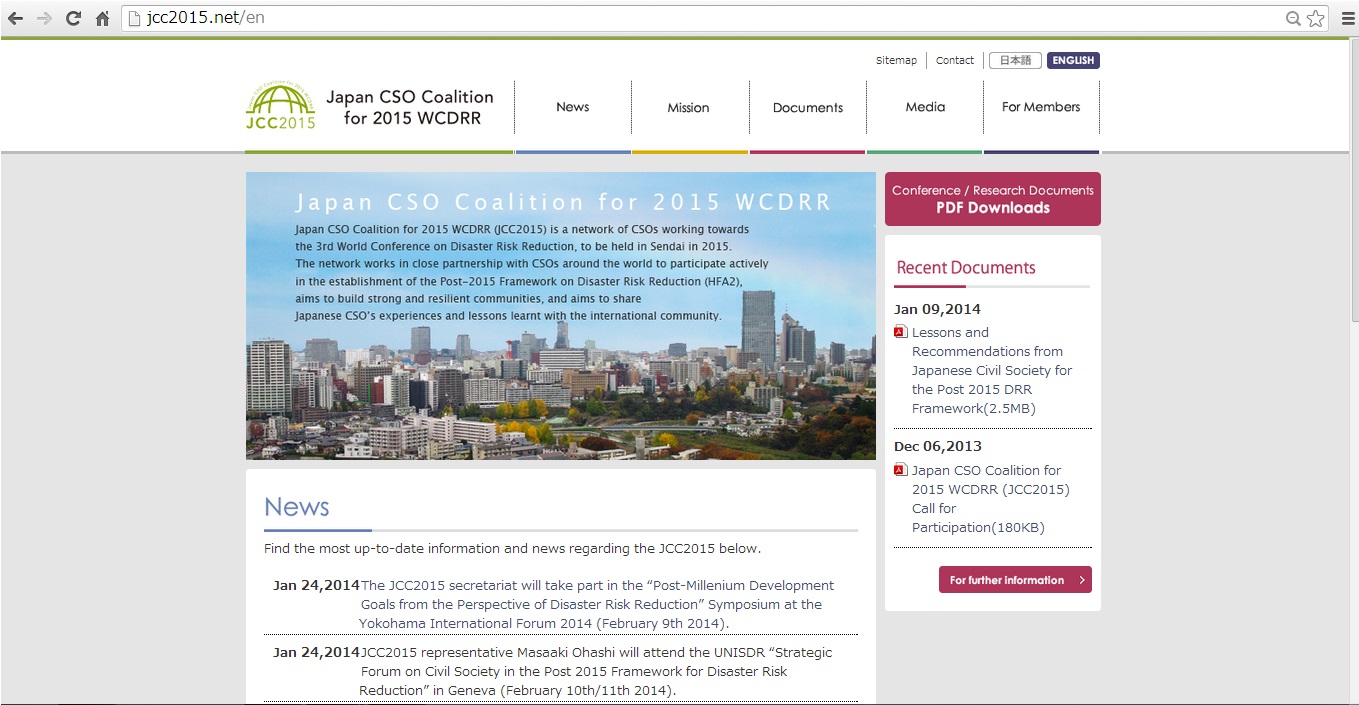
JCC2015 is a network of CSOs working towards the 3rd World Conference on Disaster Risk Reduction, to be held in Sendai in 2015.
The network works in close partnership with CSOs around the world to participate actively in the establishment of the Post-2015 Framework on Disaster Risk Reduction (HFA2), aims to build strong and resilient communities, and aims to share Japanese CSO’s experiences and lessons learnt with the international community.
The Great Hanshin-Awaji Earthquake is, in some circles, considered the birth of disaster volunteerism in Japan. Thousands of volunteers flooded into the affected areas to help out in any way they could, whether through distribution of supplies, making hot meals, or cleaning damaged houses. Compared to today’s disaster response mechanisms, volunteer activities were not as coordinated and efficient.
Today’s disaster volunteers have access to a more coordinated system; they can sign up at a disaster relief volunteer center, where they can join a team in the field. These centers are run by the local branch of the Social Welfare Council, the semi-governmental body who usually is responsible for ensuring the welfare of citizens in their municipality (E.g., caring for the elderly). After checking in at the center, volunteers are assigned a group and are dispatched to a field site. The volunteer reception center is charged with matching the needs in the community with the resources (in this case, volunteers).
This is just one example of the growth of volunteer activity and the strengthening of volunteer-related systems in disaster time since the Great Hanshin-Awaji earthquake.
In 1998, the growth of the non-profit sector led to the introduction of the Law Concerning the Promotion of Specific Non-Profit Organization Activities (a.k.a. the NPO Law). This new legislation was established to help NPOs organize effectively and to create a more official role for non-profits both in times of disaster and peace time.
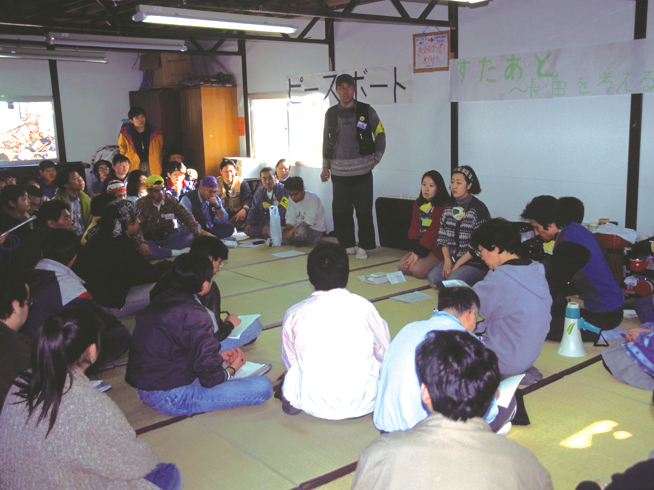
1995, volunteering in Kobe.
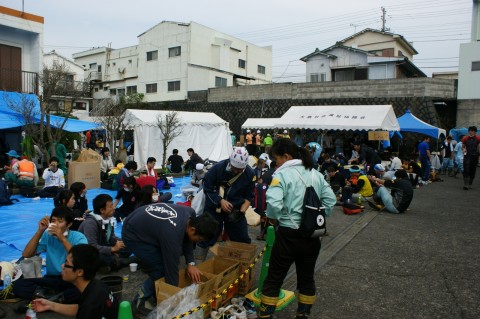
Volunteers at a disaster relief volunteer center (Oshima Island, 2013)
Japan is widely regarded as a global leader in disaster risk reduction, with a combination of knowledge, experience, infrastructural resilience and technological capabilities second to none. However, no country, no matter how prepared, is invulnerable to disasters and the frequency of both small-scale and major disasters in Japan allows no room for complacency.
This unique setting, a country at the forefront of disaster preparedness and yet so prone to disasters, may explain why every World Conference for Disaster Risk Reduction has been held in Japan to date.
There are certain issues that can be applied to many types of disasters, regardless of where they take place in the world. For example, Typhoon Haiyan in the Philippines left many areas in a similar condition to areas affected by the Great East Japan Earthquake; over 6,000 people lost their lives, and more than 1,700 people are still missing. Matters such as infrastructure and community preparedness can have a great impact on the extent to which a disaster affects a community.
Lessons learnt from countries’ experiences of disasters may be able to save lives in other countries. The 3rd World Conference on Disaster Risk Reduction provides an opportunity for global stakeholders to share their experiences and lessons learnt with other international actors. These kinds of opportunities are extremely important for the growth and improvement of international disaster risk reduction measures across the board.
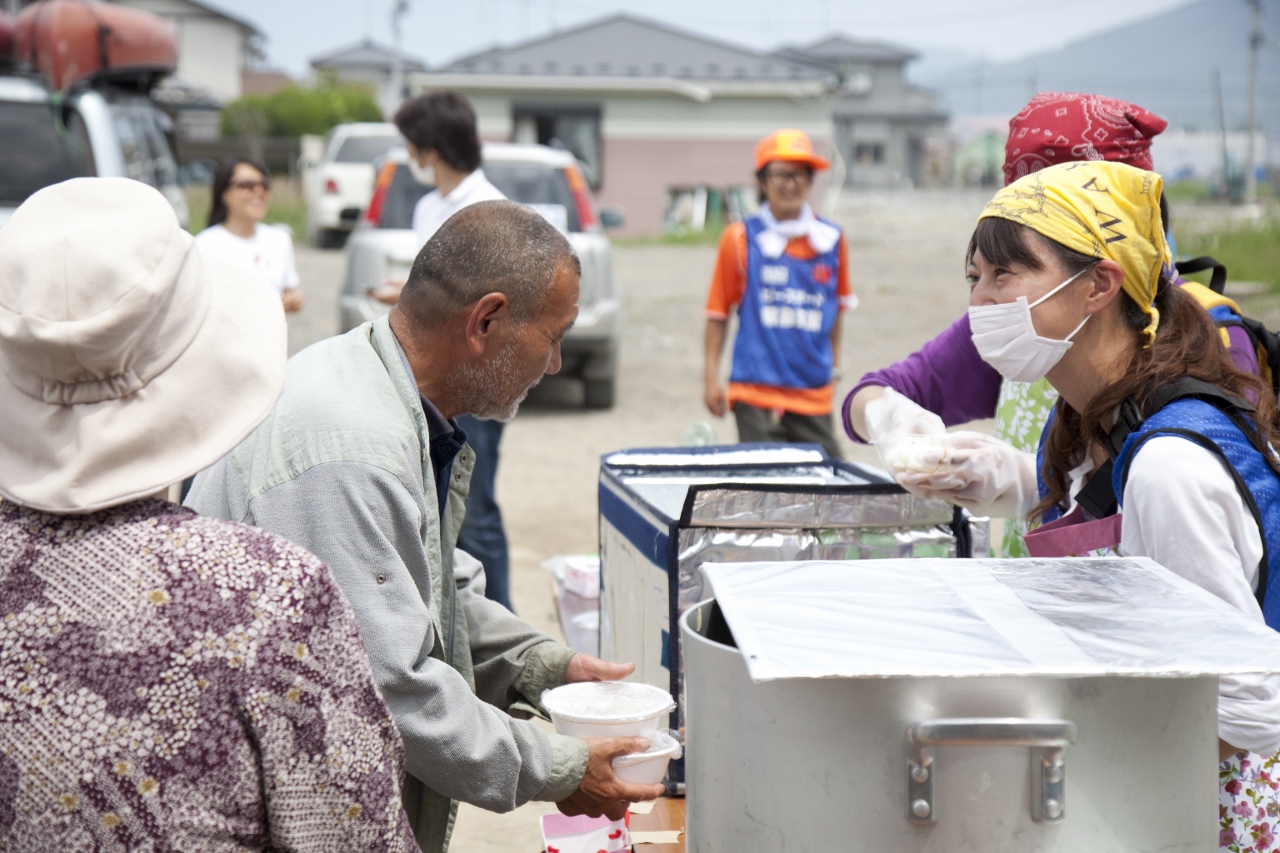
In Ishinomaki City, after the Great East Japan Earthquake, volunteers provided 10,000 hot meals to residents that could not be reached by governmental assistance.
In addition, the Great East Japan Earthquake was not only a natural disaster; the situation was severely exacerbated by the Fukushima Daiichi nuclear disaster. As we approach the 3-year mark since March 11th, the nuclear disaster is still on-going and causing immense human suffering. As an increasing number of reports regarding health issues and the effects of long-term radiation coming to light, the road to recovery is still long and uncertain.
At the Sendai conference, all nations that have nuclear facilities or are considering building them should be wary of the Fukushima disaster and the potential hazards of nuclear power on human life.
In May 2013, Peace Boat participated in the Global Platform for Disaster Risk Reduction (GPDRR), which also served as a preparatory convention for the 3rd WCDRR. We were honoured to be in attendance with Mr. Kazuo Mutou a farmer from Nihonmatsu-City, Fukushima Prefecture. A surprising reality at the GPDRR was that while many people considered the nuclear disaster a serious issue, it was not brought up in discussions at either the main conference or side-events without initiation from Mr. Mutou or a Japanese NGO/NPO.

Mr. Mutou gives a speech at the GPDRR in Geneva, Switzerland
PBV is a member of the JCC2015 network which was established last week. We strongly believe in the network’s mission to share Japan’s experiences with as many people as possible to help create a global society that can protect its citizens from disasters. It is impossible to create a disaster-proof society; therefore we should strive to create a society that helps each other through mutual assistance when the need arises.
Please see the JCC2015 official website for more information:
www.jcc2015.net/en